Product Description
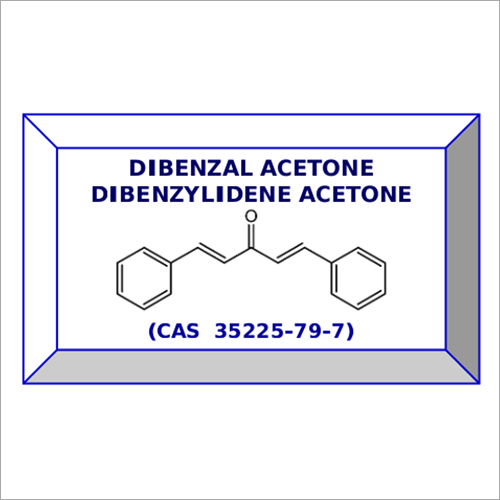
| | Grade : - Industrial Grade | | Molecular Formula : - C17H14O | | Purity : - Min 98. 0%% | | Melting Point : - 107 - 1120 Degree C | | Molar Mass : - 234.29 g/mol | Features and uses : DIBENZAL ACETONE - IT IS A PALE-YELLOW CRYSTALLINE SOLID
- PURITY MIN 98.0%% BY GC
- INSOLUBLE IN WATER, BUT SOLUBLE IN ETHANOL
- IT IS USED AS A COMPONENT IN SUNSCREENS, BECAUSE IT IS CAPABLE OF ABSORBING ULTRAVIOLET LIGHT
- ALSO USED AS LIGAND IN ORGANOMETALLIC CHEMISTRY, BECAUSE IT IS EASILY REPLACEABLE AND THEREFORE, BONDS OF THE METAL WITH OTHER LIGANDS COULD BE FORMED EASILY
| |
Broad Application in Research and SynthesisDibenzal Acetone is valued in organic synthesis, serving as an essential reagent in pharmaceutical laboratories and research institutions. Its unique chemical properties make it a preferred intermediate for experimental and commercial synthesis processes, guaranteeing consistent results owing to its high purity and quality standards.
Stringent Safety and Storage MeasuresThis product is stable under standard conditions and should be stored in a tightly closed container, kept in a cool and dry place, shielded from excessive heat and light. Gloves and goggles are recommended during handling, minimizing exposure and ensuring user safety throughout its shelf life of 24 months.
FAQs of CAS-35225-79-7 Dibenzal Acetone:
Q: How should Dibenzal Acetone be stored to maintain stability and quality?
A: Dibenzal Acetone should be kept in a tightly closed container stored in a cool, dry place, protected from excessive heat and light to ensure stability throughout its 24-month shelf life.
Q: What are the recommended safety precautions when handling Dibenzal Acetone?
A: During handling, users should wear gloves and goggles. Although the compound is non-toxic and not classified as hazardous, these measures prevent unnecessary exposure and contamination.
Q: When is a Certificate of Analysis provided for Dibenzal Acetone?
A: A Certificate of Analysis is available upon request and confirms detailed quality and specification standards, ensuring product assurance for every batch supplied.
Q: Where is Dibenzal Acetone typically used?
A: Dibenzal Acetone is applied in organic synthesis, pharmaceutical development, and laboratory research settings as a synthesis intermediate and reagent.
Q: What benefits does Dibenzal Acetone offer for chemical synthesis?
A: Its high purity (98%%) and technical grade ensure reliable performance as an intermediate in complex chemical reactions, leading to more predictable and reproducible outcomes in laboratory and industrial applications.
Q: Is Dibenzal Acetone regulated for transport or classified as hazardous?
A: Dibenzal Acetone is not classified as hazardous and is considered non-hazardous for transport. It is not regulated under UN shipping guidelines.
Q: In what packaging sizes is Dibenzal Acetone available from manufacturers in India?
A: Manufacturers supply Dibenzal Acetone in fiber drums of 25 kg and 50 kg, suitable for wholesale and bulk procurement.


 Send Inquiry








 Send Inquiry
 Send SMS
 Call Me Free